
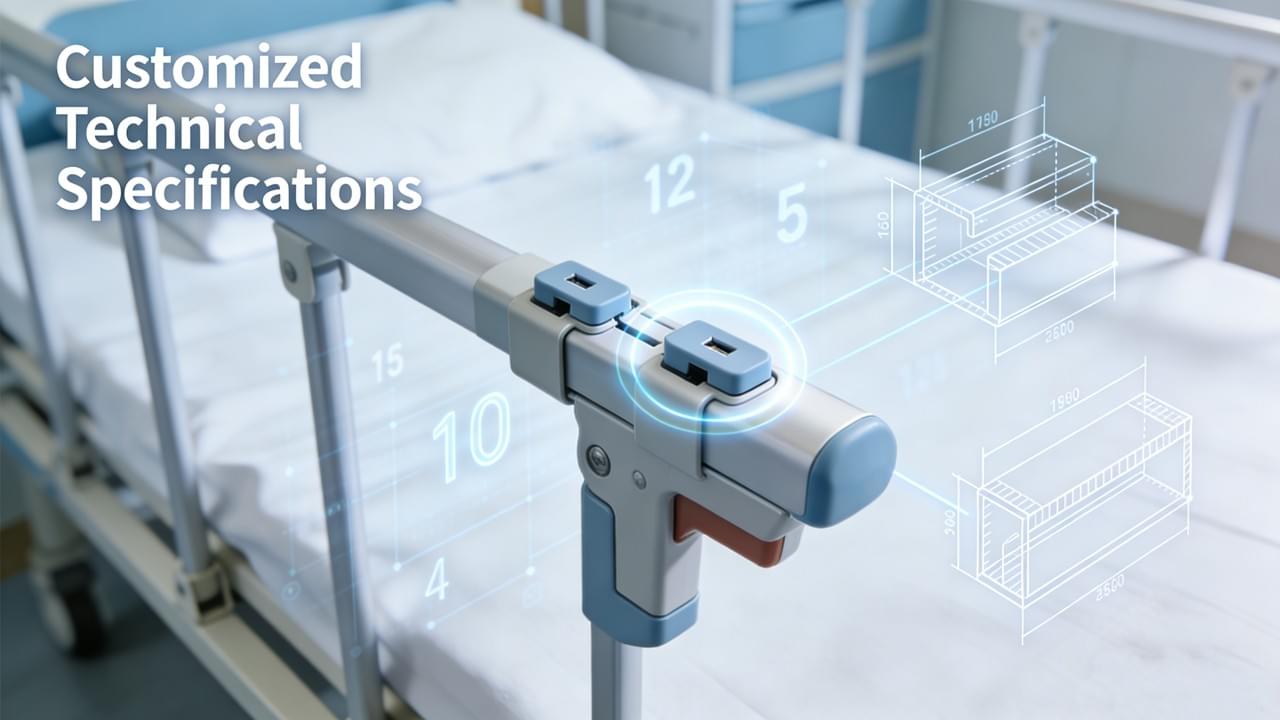
If you manage a healthcare facility or supply high-quality medical equipment, you know that patient safety is non-negotiable. Sakon’s Aluminum Safety Guardrails have set a new standard, featuring a robust build and an innovative dual-switch mechanism designed to prevent accidental release.
However, off-the-shelf solutions often fall short of meeting unique institutional needs, specific regulatory requirements, or local market demands. This is where OEM (Original Equipment Manufacturer) and ODM (Original Design Manufacturer) customization becomes crucial. This guide dives deep into the 7 critical technical specifications you must discuss to build your perfect patient safety solutions.
1.The Dual-Switch Mechanism Customization 🔒
The hallmark of Sakon rails is the added security layer provided by the dual-switch mechanism. For custom projects, this is your first point of flexibility. We need to define the operation logic. Do you require the switches to be positioned differently for caregiver accessibility? Should the mechanism integrate electronic locking or a time-delay feature for high-risk cognitive units? When engineering custom hospital bed rails, tailoring the dual-switch system directly impacts your anti-entrapment and anti-accidental release compliance. This level of detail elevates the security profile of your Aluminum Safety Guardrails.
2.Tailored Load and Rigidity Requirements 💪
Our standard Aluminum Safety Guardrails are certified to withstand $180\text{ kg}$ of pressure—a testament to their strength and rigidity. Your specific market (e.g., EU, US, or Asia) might have different regulatory standards (like IEC 60601-2-52 or FDA guidelines) for static and dynamic load testing. In an OEM project, we can adjust the aluminum profile thickness and internal reinforcement structure to meet or exceed higher thresholds, guaranteeing that your Aluminum Safety Guardrails maintain structural integrity under exceptional patient pressure.
3.Material Grade and Environmental Durability 🔬
While the core advantage of our rails lies in the use of high-quality, lightweight, and corrosion-resistant aluminum alloy, the material grade can be further optimized. For environments with high humidity, saline exposure, or frequent use of harsh chemical disinfectants, specifying a particular aluminum alloy (e.g., 6000 series) ensures enhanced corrosion resistance and long-term performance. This detailed focus on material science guarantees durability and ease of maintenance, making these truly custom hospital bed rails.
4.Customizing Aesthetics and Finishings 🎨
Beyond clinical functionality, appearance matters, especially in elder care and specialized nursing facilities. While our standard brown color offers an exquisite appearance, ODM allows you to define the finishing. Options range from specific powder-coating colors (e.g., calming blues or neutral grays) to different textures that improve grip or cleaning efficiency. This customization ensures your Aluminum Safety Guardrails seamlessly integrate with your facility’s interior design and branding.
5.Precise Compatibility and Interface Design 🔩
The most critical technical challenge in producing custom hospital bed rails is achieving perfect compatibility. We require detailed schematics of your existing or planned nursing beds and mattresses. Our engineering team designs a proprietary mounting bracket and interface that locks securely to your specific bed frame, optimizing the guardrail’s height and spacing to prevent entrapment zones. This precise fit is essential for a robust patient safety solution.
6.Adjusting Height, Length, and Anti-Entrapment Specs
The overall dimensions—the length and height of the rail—are customizable to accommodate varying mattress depths or patient sizes (bariatric or pediatric). Crucially, the spacing between the rail components must adhere to strict international anti-entrapment compliance standards. Customization here involves careful simulation and prototyping to ensure your Aluminum Safety Guardrails meet all safety zone requirements, especially zones 1–4, as defined by regulatory bodies.
7.Integration with Bed Controls and Electronics 💡
For advanced hospital beds, the guardrail often serves as the primary control panel. An ODM project can integrate specific electronic components, such as patient lockout controls, nurse call buttons, or even specialized indicators, directly into the rail housing. Discussing these electronic and wiring specifications ensures your custom hospital bed rails function as a cohesive and smart component of the entire bed system.
Ready to Design Your Ultimate Patient Safety Solution?
Designing the perfect Aluminum Safety Guardrails requires technical expertise, a deep understanding of safety standards, and a trusted OEM/ODM partner. By focusing on these 7 critical technical specs, you can move beyond standard offerings to deploy a genuinely tailored and superior patient safety solution for your patients.
We are ready to translate your institutional requirements into a high-performance product. Get a Free Quote now to start the technical design consultation for your customization order. If you want to see our full range of customizable components, check out our product page: Sakon Medical Custom Parts.